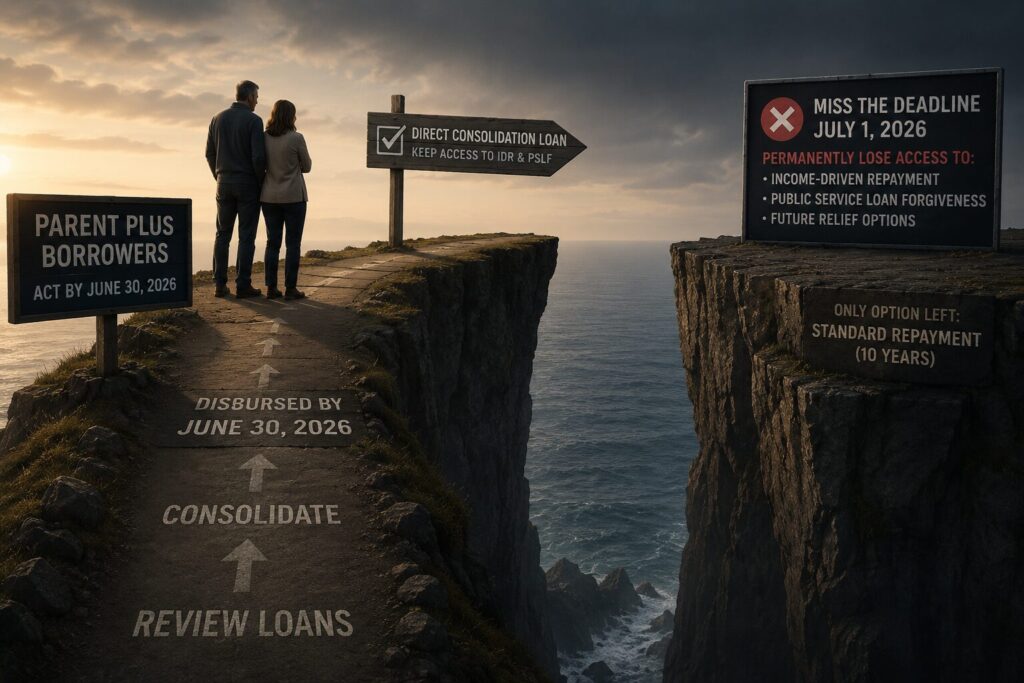
The June 30, 2026 consolidation deadline has passed. If a Parent PLUS borrower did not have a Direct Consolidation Loan disbursed on or before that date, income-driven repayment is now closed to them permanently. There is no recovery path and no appeal.
If they did consolidate in time, they have exactly one deadline left, and it is the one almost nobody is tracking: June 30, 2028. A client who sits on that consolidation loan without acting loses access to income-based repayment for good. The fix takes one plan enrollment and one payment, and it has to happen inside the window.
This page is the advisor version of that problem: who still has a live window, what the 2028 rule actually says, and how to find the affected clients in your book.
What changed on July 1, 2026?
The One Big Beautiful Bill Act (P.L. 119-21) changed the rules for Parent PLUS borrowing in two ways. Starting July 1, 2026, new Parent PLUS loans are capped at $20,000 per year and $65,000 lifetime per dependent student, a sharp departure from the prior cost-of-attendance-based ceiling. That is the borrowing side, which matters for current college parents.
The repayment side is the cliff. Parent PLUS loans have never been directly eligible for income-driven repayment. They had to be consolidated into a Direct Consolidation Loan, which then qualified for Income-Contingent Repayment (ICR) and only ICR. That pathway remained open only through June 30, 2026. A Parent PLUS loan consolidated after that date produces an excepted consolidation loan, which is shut out of income-driven repayment entirely.
The Repayment Assistance Plan (RAP) that replaced most federal repayment options on July 1, 2026 explicitly excludes Parent PLUS loans and any consolidation loan that includes Parent PLUS funds. RAP is not a fallback here. For this population it does not exist.
Who still has a live window?
Two cohorts, and the difference between them is now fixed history rather than something an advisor can influence.
- Consolidated on or before June 30, 2026. These clients have a live window until June 30, 2028. They are the entire population this page is about, and they are the ones to find this quarter.
- Did not consolidate in time. Their Parent PLUS debt is on the Standard plan or a comparable fixed schedule for the life of the loan. Income-driven repayment is gone. The planning conversation shifts to cash flow, refinancing math, and in some cases whether the parent should be carrying the debt at all. For the general consolidation decision outside the Parent PLUS case, see should I consolidate my student loans?
Finding cohort one means identifying clients with federal loans in a parent’s name rather than the student’s, then confirming a Direct Consolidation Loan that includes Parent PLUS funds and checking its disbursement date. If your intake has never captured loan-holder-name detail, that is a separate problem worth solving before the next deadline finds you.
What is the June 30, 2028 deadline?
It is the date the escape hatch closes. A Direct Consolidation Loan that repaid a Parent PLUS loan is an excepted consolidation loan, and excepted consolidation loans cannot use income-based repayment. But the statutory definition carries an exclusion, and the exclusion is the whole planning opportunity.
Under 20 U.S.C. §1098e(a), a consolidation loan does not count as an excepted consolidation loan if, on any date during the period beginning July 4, 2025 and ending June 30, 2028, it was being repaid under the Income-Contingent Repayment plan or another income-driven repayment plan. Once that condition is met, the excepted label falls away and income-based repayment stays available to that borrower going forward.
The practical sequence is short. Get the qualifying consolidation loan onto ICR before the window closes, and the borrower keeps access to IBR afterward. Note the statutory trigger carefully: the test is that the loan was being repaid pursuant to ICR or another income-driven plan on any date inside the window. Do not tighten that to a payment-count test. The loan also does not have to stay on ICR once the condition is met.
Two dates close together here, and that is not a coincidence. ICR itself is eliminated as of June 30, 2028, and Parent PLUS borrowers still repaying under ICR on that date are moved to IBR. So the plan that opens the door and the window the door sits in expire at the same moment. A client who starts this in June 2028 is unlikely to finish it.
What happens if they miss it?
The consolidation loan keeps its excepted status permanently. Income-based repayment is unavailable, RAP is unavailable by statute, and the borrower repays on a fixed schedule regardless of income for the remaining life of the loan. For a parent who borrowed six figures for a child’s education and is approaching retirement on a fixed income, that is not a pricing inconvenience. It is a materially different retirement.
There is also no partial credit. The exclusion is binary: the loan was repaid under an income-driven plan inside the window, or it was not.
Advisor action checklist
- Scan the book for parent borrowers now. Filter for federal loans held in a parent’s name. This is the step most firms skip because the data was never captured at intake.
- Confirm the consolidation and its disbursement date. On or before June 30, 2026 means a live window. After that date means the conversation changes to cash flow and refinancing.
- Check current plan enrollment. A qualifying borrower already repaying under ICR has satisfied the condition. One who consolidated in time but never enrolled has not, and is the client most at risk of quietly losing IBR.
- Do not wait for 2028. Servicer processing, income documentation, and the ICR sunset all land in the same window. Treat mid-2027 as the practical deadline.
- Model both outcomes side by side so the client sees the cost of inaction as a number rather than a warning.
The one thing to remember
The RAP transition gets most of the public attention because SAVE was bigger and more visible. The Parent PLUS situation is narrower and more severe. A SAVE borrower moving under the Department’s transition notice has alternative plans to choose from. A Parent PLUS borrower who consolidated in time and then does nothing before June 30, 2028 has no recovery path, ever.
The clients who need this are unlikely to raise it themselves. Most of them do not know the 2028 date exists. Model your parent-borrower clients in the Federal Loan Simulator and find the ones with a window still open.
Sources: One Big Beautiful Bill Act (P.L. 119-21); 20 U.S.C. §1098e(a) (definitions of excepted PLUS loan and excepted consolidation loan, including the July 4, 2025 through June 30, 2028 exclusion) and §1098e(b)(1); 20 U.S.C. §1087e(d) (repayment plan menu, the July 1, 2026 limitation, and the RAP exclusion of excepted loans); Department of Education Dear Colleague Letter, July 18, 2025; Federal Register NPRM “Reimagining and Improving Student Education” (91 FR 5627, Jan. 30, 2026); Eighth Circuit ruling vacating the SAVE Plan (March 10, 2026); Department of Education press release announcing SAVE next-steps (March 27, 2026); Congressional Research Service Report IF13075.
This is informational content for licensed advisors. Specific guidance for any individual borrower requires their loan data and circumstances.
Model the 2026 rules for a real client.
Run RAP, the new Standard, IBR, PAYE, ICR, and PSLF side by side, verified to the cent, and hand the client a report. Free 7-day trial.
- What Happens If You Don’t Recertify Your Student Loan Income?
- Parent PLUS After July 1, 2026: What Is Actually Left
- Credit Card Hardship Programs: What Happens When You Finally Answer the Bank’s Call
- How to Tell If Your Program Will Still Qualify for Federal Student Loans
- Parent PLUS Loans: The 2026 Guide
Run a client-ready repayment plan in minutes
Every number sourced, every path compared. Model RAP, the new Standard, IBR, PAYE, ICR and PSLF side by side.