Credit Card Hardship Programs: What Happens When You Finally Answer the Bank’s Call
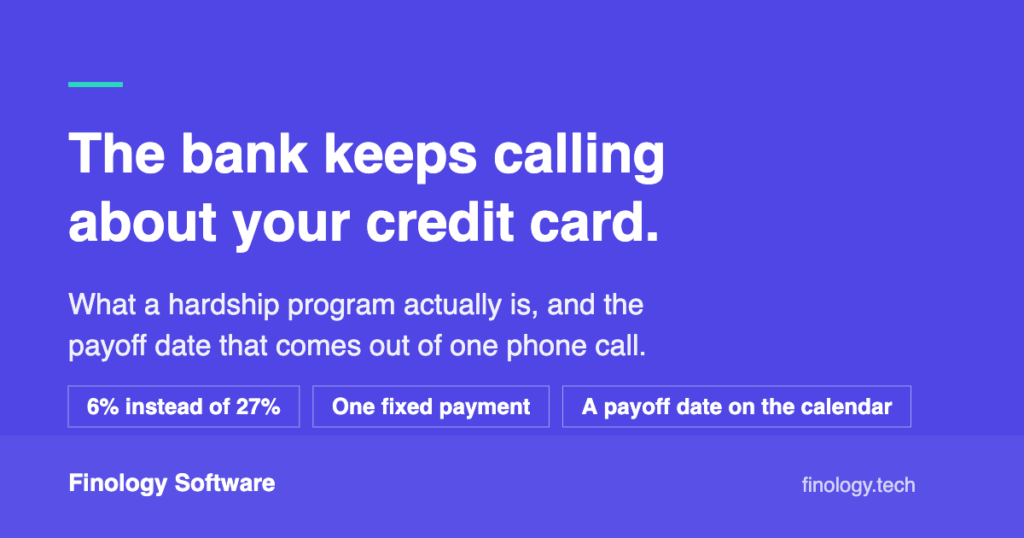
You know the number by now. It rings while you are at work, while you are driving, while you are sitting in a parking lot deciding whether today is the day you pick up. The balance has stopped feeling like a number and started feeling like weather, something that is just always there. If that is where you are right now: this article is about the phone call that changes it, what the bank will actually say when you answer, and the plan with dates on it that can come out of that conversation.
Here is the part almost nobody tells you. The person on the other end of that call is usually not calling to threaten you. They are calling to ask one question: what is going on? And when you answer honestly, most major card issuers have a formal program ready for exactly this moment. The Consumer Financial Protection Bureau calls these loss mitigation programs. Card companies call them hardship programs. Either way, the CFPB’s advice is simple: contact your credit card company right away, because these programs exist and the earlier you ask, the more options you have.
What is a credit card hardship program?
A credit card hardship program is an agreement with your card issuer that restructures what you owe into something you can actually pay. The details vary by issuer, but the typical shape looks like this:
- A much lower interest rate. Instead of a purchase APR in the 20s or 30s, hardship programs commonly run in the single digits, sometimes as low as 0%.
- A fixed monthly payment. The same amount every month, agreed up front.
- A defined end date. Terms of up to 60 months are common. You pay the balance in full, and then you are done. There is a specific month, on a calendar, when this ends.
- The card is paused or closed while you are enrolled. The account stops being a revolving card and becomes, in practice, a simple installment loan.
- Automatic payments, at least at first. Many issuers set the first few payments on autopay as a condition of enrollment.
That last structural point matters more than it looks. A hardship plan converts an open-ended debt with a moving target into a fixed-rate, fixed-term, fixed-payment loan. It is the same math as a car loan. And that means, for the first time, your payoff date is a fact instead of a hope.
What the numbers actually look like
Take a $30,000 balance at a 26.99% APR, which is an ordinary purchase rate in 2026. The interest alone on that balance is $674.75 every month. Before a single dollar reaches your principal, the first $675 of whatever you send is gone.
Now put that same balance side by side with a typical hardship plan at 6% over 60 months:
| Paying minimums at 26.99% | Hardship plan, 6% for 60 months | |
|---|---|---|
| Monthly payment | $974.75 to start, declining slowly | $579.98, fixed |
| Time to payoff | About 35 years | 5 years |
| Total interest paid | $66,299.54 | $4,798.80 |
Read that again, because it is the whole story in one row: the hardship plan is almost $400 less per month, it is over 30 years sooner, and it costs about $61,500 less in interest. Minimum payments are calculated as interest plus a small slice of principal, which is why they can take decades. The hardship plan simply removes the treadmill.
These figures are computed, not estimated: standard amortization, with the minimum-payment column modeled as interest plus 1% of the balance each month, the convention many issuers use. Your card’s exact terms will differ, and that is exactly the kind of thing worth seeing in your own numbers, which we will get to below.
What to ask before you say yes
When the offer comes, it will come fast, usually in the same phone call. You get to slow it down. Ask these, and write the answers down while you are still on the line:
- What is the interest rate during the program, and is it fixed for the whole term?
- How many months is the term, and what is the exact monthly payment?
- What happens to the account, closed, frozen, or reopened at the end?
- Which payments are on autopay, and when can I switch to paying manually?
- How will you report this account to the credit bureaus while I am enrolled?
- Do late fees and penalty interest stop once I am in the program?
- What happens if I miss a payment inside the program?
One practical safety note: make this call yourself, using the phone number printed on the back of your card or on your statement. That way you know exactly who you are talking to.
Will a hardship program hurt my credit?
It depends on where you are starting from and how your issuer reports the account, which is why that question is on the list above. Two honest things can be true at once. First, the account will usually be closed or frozen, which can raise your overall credit utilization, and any late payments that already happened stay in your history. Second, a fixed plan you actually make every payment on builds a record of on-time payments, and it beats the alternative it is replacing, which is continued missed payments marching toward charge-off or collections. Ask your issuer directly how they report enrolled accounts, and get the answer in writing if you can.
Is a hardship program the same as debt settlement?
No, and the difference matters. In a hardship program you repay the full balance at a reduced rate, directly with your issuer, at no cost. Debt settlement means paying less than you owe, usually after months of deliberate non-payment, and it does serious, lasting damage to your credit. If you want help beyond what your issuer offers, the CFPB points to nonprofit credit counseling agencies, which can set up a debt management plan across several cards. Start with the free option: your own issuer’s hardship program.
The five years after the phone call
Enrolling is the hard part emotionally. It can feel like admitting something. Here is a better frame, and it happens to be the accurate one: you converted an open-ended spiral into a finish line. You now have a number, a date, and a plan that ends.
What comes next is quieter and longer: sixty payments. The people who get through them well tend to do one specific thing, they keep the plan somewhere they can see it. Not in a drawer with the paperwork, but somewhere that shows the balance going down, the payments made versus payments left, and the payoff date getting closer. Month 12 of 60 feels completely different when you can see that you are a fifth of the way out.
That is exactly what a free Finology Software borrower account gives you. Add the card with your plan’s rate, payment, and term, and you get your payoff date, your total interest, and a running picture of your progress you can check any time, alongside any other loans you are carrying. When you have a little extra in a good month, you can see precisely what an extra $50 does to that finish line before you send it. Create your free account and put the plan where you can see it.
You picked up the phone. That was the brave part. The rest is just sixty small wins in a row, and you get to watch every one of them land.
Sources: Consumer Financial Protection Bureau, What should I do if I can’t pay my credit card bills?; CFPB, Need help with your credit card debt? Start with your credit card company. Example figures computed with standard amortization at the stated rates and terms. Verified July 22, 2026.
Put your plan where you can see it
Add your loans and your plan in a free borrower account. See your payoff date, watch your progress, and know exactly what an extra $50 a month changes.