
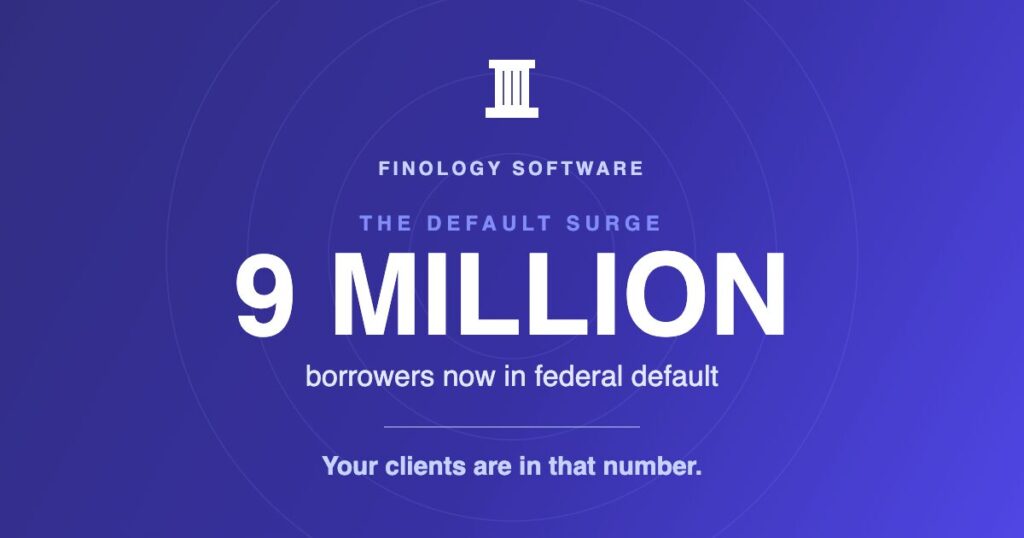
Federal student loan defaults just hit a record. As of this spring, more than 9 million borrowers are in default, up from 7.7 million at the end of last year. The Department of Education’s own projections say that figure could pass 12.5 million by the end of 2026 if nothing changes.
That is not a niche problem anymore. One in eight federally managed borrowers is now in default. If you advise households with any student debt, some of them are already in that count, and more are one missed statement away from joining it.
And it is not only your clients. It is their kids and their grandkids. An adult child who was moved off SAVE, a grandchild who never opened the collections notice, a Parent PLUS loan the family stopped tracking years ago. Much of this exposure is invisible from where you sit, which means you may be the only person positioned to catch it before it does real damage.
How we got here
Two things happened at once.
The four-year collections pause ended, so the consequences that were frozen since 2020 are live again. Wage garnishment, seized tax refunds, and offset Social Security benefits are back on the table.
At the same time, the SAVE plan was unwound, and millions of borrowers were pushed off the repayment plan they had signed up for and onto something else. A lot of them do not know what their new payment is, whether they can afford it, or that the clock on default consequences is already running.
The result is a wave of people who are not deadbeats. They are confused. They got moved, the pause lifted, and no one walked them through what changed.
Why this is an advisor moment, not just a headline
Default is one of the few money problems where the fix is procedural, not just behavioral. A borrower in default has real options: rehabilitation, consolidation out of default, and a return to an income-driven plan that reflects what they actually earn. The catch is that the path is confusing, the paperwork is unforgiving, and the wrong move can cost years of progress toward forgiveness.
That gap is exactly where an advisor earns trust. Most borrowers have never had anyone show them the actual numbers: what each plan costs per month, what it costs over the life of the loan, and when forgiveness lands under RAP versus ICR. When you can put that on the screen in front of a client and say here is your way out, and here is what it saves you, you stop being a portfolio manager and start being the person who fixed the thing that was keeping them up at night.
Households do not switch advisors over an extra 20 basis points. They switch, and they refer, over the person who got them out of default.
If you have ever wanted a place to give back
Plenty of planners want to do pro bono work and never find the right fit. The problem is usually scope. Open-ended financial coaching has no finish line, and most volunteers do not have room in their week for an indefinite commitment.
Getting a borrower out of default is the opposite of that. It is bounded, it is concrete, and it has a clear finish. You are not managing anyone’s portfolio or signing on as their advisor. You are sitting with one person, reading their loan status, and walking them through the specific steps to rehabilitation or a new plan. A single session can change the trajectory of a household that thought garnishment was inevitable.
Nine million people need exactly this, and almost none of them can afford to pay for advice to get it. If you have been looking for a way to use your license that actually helps someone, this is it. Take one case. Then take another.
What to do this quarter
Pull every client’s federal loan status before year-end, and get anyone in or near default onto the right plan now. That is the whole play. Not a campaign, not a webinar series, just a status check on every household with student debt while the options are still open and before another garnishment cycle runs.
Historically, getting this right took years of specialized study. Credentials like the CSLP and CCFC are a great starting point, and the hardest parts genuinely reward that depth. But most of that complexity lives at the high end: higher earners with multiple loans, tax-filing tradeoffs, and PSLF timing to optimize. Getting a borrower out of default and onto an affordable plan is not that case. It is far more tractable.
What advisors need to help here is a tool for a focused conversation: who is exposed, and the exact path out with real dollar figures. Finology Software runs the federal repayment math for you, plan by plan, so the conversation is about the client’s decision instead of your spreadsheet.
Nine million is a number. The client sitting across from you is not. Go find the ones in that number who are yours, and get them out.
Put your plan where you can see it
Add your loans and your plan in a free borrower account. See your payoff date, watch your progress, and know exactly what an extra $50 a month changes.