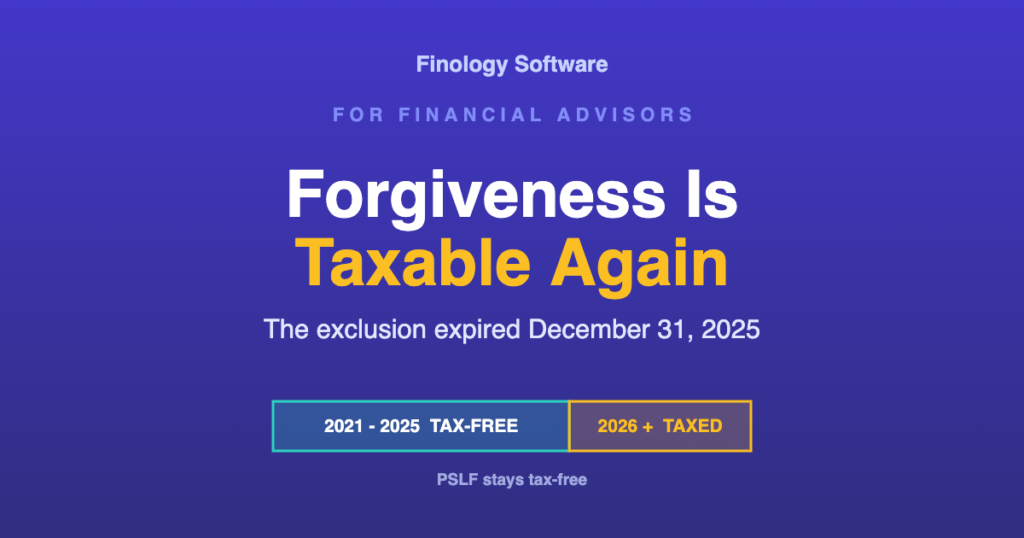
For five years the tax question did not matter. The American Rescue Plan excluded discharged student debt from gross income for loans forgiven between 2021 and the end of 2025, so an entire cohort of advisors learned the plan comparison without a tax line in it.
That provision expired on December 31, 2025 and was not extended. Loans forgiven on or after January 1, 2026 are once again treated as cancellation of debt income, reported on Form 1099-C and added to gross income on the borrower’s 1040.
Which means the tax line is back in every income-driven projection, and almost nobody is modeling it.
What is still tax-free
Two things, and they are the exceptions worth knowing cold.
Public Service Loan Forgiveness. PSLF is excluded under separate, permanent provisions. A client who reaches 120 qualifying payments owes nothing on the forgiven balance. This is now the single largest difference between the PSLF track and everything else, and it is worth more than the payment difference in most cases.
Death and total permanent disability discharge. Permanently excluded.
Everything else, the 240-payment IBR forgiveness, the 300-payment cohort, the 360-payment RAP forgiveness, is ordinary income in the year it lands.
What it actually costs
We ran four borrowers through our engine and priced the tax at 2026 federal brackets, from Rev. Proc. 2025-32. A 6.53% blended rate, income growing 3% a year, no state tax:
| Client | Plan | Forgiven | Income that year | Federal tax |
|---|---|---|---|---|
| $45k balance, $52k income | IBR (20 yr) | $20,255 | $91,182 | $4,571 |
| $80k balance, $90k income, married, 2 kids | IBR (20 yr) | $75,306 | $157,816 | $17,002 |
| $120k balance, $75k income | IBR (20 yr) | $139,520 | $131,513 | $39,470 |
| $120k balance, $60k income | RAP (30 yr) | $17,293 | $141,394 | $4,150 |
Three things in that table are worth an advisor’s attention.
1. It is taxed at the income they will have, not the income they have
This is the error we see most often. An advisor estimates the tax bomb using the client’s current salary, because that is the number on the file.
The tax is assessed in the forgiveness year. For a borrower twenty years out with ordinary raises, that is a different tax bracket entirely. The $75,000 earner in row three is making $131,513 by the time forgiveness arrives, and the forgiven balance stacks on top of that.
Estimating from today’s income understated the bill by about $5,600 in that case. The direction of the error is always the same: today’s salary makes the tax look smaller than it will be.
2. RAP produces a much smaller tax bill, and not for the reason you would guess
Compare rows three and four. Both borrowers carry $120,000. The IBR borrower has $139,520 forgiven and owes $39,470. The RAP borrower has $17,293 forgiven and owes $4,150.
The tax treatment is identical. The difference is how much is left to forgive.
RAP waives unpaid interest and adds a monthly principal credit, so the balance cannot balloon. IBR has no such mechanic, so an unaffordable payment lets the balance grow for two decades and the borrower is forgiven a number far larger than what they borrowed. The tax bomb is a function of negative amortization, and RAP largely eliminates it.
That is a real point in RAP’s favor that gets lost because RAP’s monthly payment is often higher. The comparison is not just payment against payment. It is payment, plus forgiveness horizon, plus what the balance does in between, plus the bill at the end.
3. It arrives in one year, in one lump, with no withholding
This is a cash-flow event, not a rate problem. Nothing is withheld. There is no installment plan by default. A client who has been making a modest payment for twenty years gets a 1099-C and a bill that in row three exceeds a year of their original loan payments.
The good news is that it is the most predictable large expense in a financial plan. The date is knowable two decades ahead, and so is the approximate size. A client who saves toward it from year one is fine. A client who discovers it in the forgiveness year is not.
What to do with this
Put the forgiveness year on the plan. If a client is on a forgiveness track, the tax year belongs in the projection as a line item, not a footnote.
Model it at projected income. Not at today’s.
Check the state. Some states tax discharged student debt and some conform to the federal treatment. This varies and it changes, so confirm the client’s state rather than assuming.
Know that the insolvency exclusion exists. Under IRC 108, a borrower whose liabilities exceed their assets immediately before discharge may exclude some or all of the cancelled debt. It is a real planning avenue for the right client and it is a conversation to have with their tax professional, not a default assumption.
Re-run PSLF eligibility. For a client anywhere near a qualifying employer, the tax-free treatment is now worth more than it has been in five years. That comparison deserves a fresh look even for clients who ruled it out before.
The comparison changes once you price it
The uncomfortable finding from our earlier modeling was that once the tax is included, forgiveness frequently loses to simply paying the loan. The borrower in row three pays $137,200 on IBR and then owes $39,470, for a true cost of $176,670. The Standard plan would have cost them $163,729.
Forgiveness still wins for plenty of clients, particularly those on PSLF and those whose balance dwarfs their income. But it is no longer automatic, and the only way to know is to price the tax rather than assume it away.
Related reading: How much do federal repayment programs actually save you and RAP or IBR? The decision framework.
Model the forgiveness tax on any client’s actual loans at finology.tech. Already have an account? Log in.
Federal brackets are tax year 2026 per IRS Rev. Proc. 2025-32. Figures are engine illustrations, not projections of any specific borrower’s loans, and nothing here is tax advice.
Show every client the plan that saves them the most
Every number sourced, every path compared. Model RAP, the new Standard, IBR, PAYE, ICR and PSLF side by side.