
Building got cheap. Maintaining didn’t. That gap is about to decide which software companies are still here in ten years, and most firms are pricing it exactly backwards.
I moved from California to Idaho in 2021. At the time people treated that as a lifestyle decision with a business cost attached.
It wasn’t. Location had already stopped being a constraint and most people had not noticed yet. Talent, capital and customers were all going remote. The thing everyone still organized their companies around had quietly expired.
That keeps happening. And it is happening again right now, with something bigger than geography.
The constraint that just expired
Software development used to be one of the largest line items at Finology Software. It is now one of the smallest. Thanks to Anthropic.
Most people building software right now could say something similar. What I think people are getting wrong is what that shift means. Also we had four years of infrastructure development which accelerated our capabilities, someone starting from scratch can’t achieve this.
The common read is that this is a margin story. Software got cheaper to make, so the companies that make it keep more of the money. That is true and it is the least interesting thing about it.
The bigger read is that it changed what size a company has to be. One person can now run a thriving software business. Finology Software is me and AI. That is not a stunt or a stage I am trying to grow out of. It is the shape of the company.
The part that did not get cheap
There are two costs in software. Building it, and keeping it right. Only one of them collapsed.
Finology Software builds tools for federal student loan repayment. The rules there change every year, and they changed more in the last twelve months than in the decade before it. A plan was struck down by a federal court in March. A new default plan took effect on July 1. Two older plans closed to new enrollment. The definition of who counts as a “new borrower” quietly moved, and it decides whether someone repays over twenty years or twenty five.
None of that is code. All of it is knowing which rule moved and when.
That cost did not fall. It is the same work it always was, and it never ends.
What a niche actually is
People define niche software by market size. Small market, few customers, limited upside.
I think the better definition is maintenance. A niche is a domain where the rules move on somebody else’s schedule, being wrong costs real money, and the revenue never justified paying a team to watch it full time.
That is why the software did not exist. Not because nobody wanted it. Because nobody wanted to own it forever.
Which is exactly what changed. AI did not make maintenance free, but it made a maintenance burden that used to require a team carryable by one person. So the niches that were previously unservable are now servable.
That is the opportunity. Not that software got cheaper to build. That a whole category of software that was never worth owning is now worth owning, by a particular kind of owner.
Why this builds a company that lasts
The question a customer actually asks about a small vendor is whether it will still be here in five years. It is a fair question and it deserves a real answer.
Most software vendors do not disappear because customers left. They disappear because the next round did not come, or because growth stalled and the company was built to require growth. A profitable business with almost no fixed cost is not exposed to either of those. It does not need permission to continue.
That structure produces things a customer can actually feel:
Speed when the rules move. There is no sprint planning, no handoff, no queue. The person who understands the regulation is the person who ships the change. When a plan gets struck down in March, that matters more than headcount.
A moat that compounds instead of decaying. Four years of infrastructure and every rule change since is an asset a newcomer cannot buy. Somebody with the same AI tools starts at zero on the only part that is hard.
Correctness treated as the product. In most software a number gets typed in once and never looked at again, so the code slowly becomes the authority instead of the law. We work the other way, from the regulation to the number, and check again when the rules move. An advisor can ask where a figure came from and get an answer.
No pressure to sell early or pivot away. The company can stay pointed at the same customers for as long as they need it, because nothing about the cost structure demands otherwise.
For anyone looking at this as an investment rather than a purchase, that is the same list read differently. High margin, low fixed cost, pricing power in a market nobody else wants to enter, and a maintenance burden that keeps newcomers out rather than letting them in.
Where this goes
If small vertical software businesses become viable and profitable at one-person scale, they become an asset class. Individually they are too small for anyone to chase one at a time, which means they get accumulated rather than acquired.
That model is not a prediction. Constellation Software has spent thirty years buying tiny vertical software companies nobody else wanted and nobody else understood, and it worked because those businesses have the one thing that survives cheap development: a domain that punishes newcomers. AI massively expands the supply of companies that fit that description.
It happens at larger scale too, and it happened where I live. Clearwater Analytics built investment accounting software for institutional investors out of Boise, went public in 2021, and was taken private this June. Vertical financial software with a real moat does not stay independent forever. Somebody buys it.
For what it is worth, Idaho is not the void people assume. Micron crossed a trillion dollars in market value this May, out of Boise. Albertsons is here. Lamb Weston is here. Clearwater built financial software for institutional investors here for two decades.
What the buyers are getting wrong
Right now every large financial firm is pointing AI at its biggest software vendors. Rebuild the expensive platform, cut the contract. On big generic systems that math often works, because the functionality is commoditized and the price is enormous.
The same exercise makes them blind to the small vendors. A tool that costs less than a rounding error on the big contract never appears in a vendor rationalization review.
That is exactly backwards. The expensive generic platform is the one AI actually helps you replace. The niche tool is the one it does not, because the moat was never the code. And it is available for a fraction of what the rebuild will cost, already correct, already maintained, already carrying the institutional knowledge of a domain nobody at the firm wants to learn.
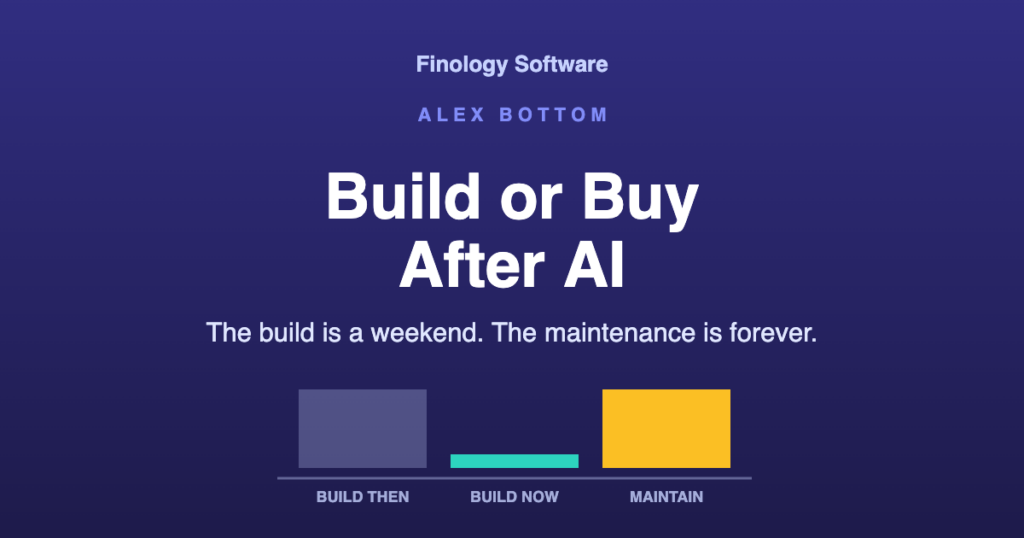
Firms are treating buy versus build as a question about build cost. AI just made that number look tiny. But the build is a weekend. The maintenance is forever.
The pattern
Location stopped being a constraint years before people stopped organizing around it. Headcount is doing the same thing now.
The companies that will still be here in ten years are not the ones that got biggest fastest. They are the ones that picked a domain worth understanding, learned it properly, and built a cost structure that lets them keep showing up. That was always the recipe. It just used to require a lot more people.
Run a client-ready repayment plan in minutes
Every number sourced, every path compared. Model RAP, the new Standard, IBR, PAYE, ICR and PSLF side by side.