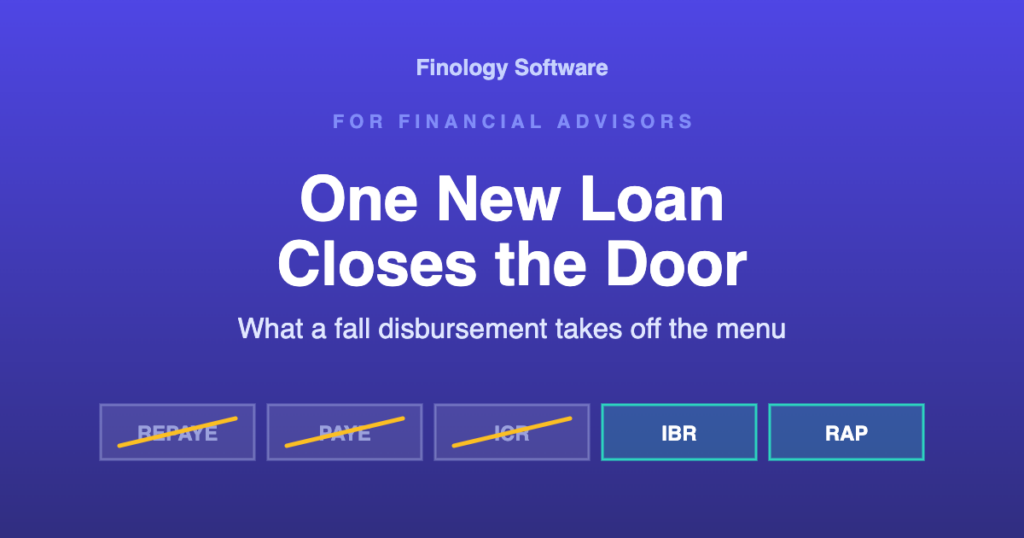
Fall disbursements are landing right now. For any client with existing federal loans who is also borrowing this semester, or whose return to school you helped plan, a single new Direct Loan disbursed on or after July 1, 2026 permanently changes which repayment plans they can ever use.
Most summaries of this rule say a new loan “locks the borrower into RAP.” That is not quite what the regulation does, and the difference matters, because the real damage lands somewhere most advisors are not looking.
What a new loan actually closes
34 CFR 685.209 attaches the same condition to three plans. A borrower may use them only if they have not received a Direct Loan on or after July 1, 2026:
- REPAYE, under (c)(2).
- PAYE, under (c)(4)(v).
- ICR, under (c)(5)(i)(C).
The alternative repayment plan closes too. Under 34 CFR 685.221(a), it is available only to a borrower “who has not received a Direct Loan on or after July 1, 2026.”
Those closures are absolute and permanent. There is no cure, no reapplication, no waiver.
What it does not close
Here is where the common framing goes wrong. IBR survives.
Paragraph (c)(3)(i) says any Direct Loan borrower may repay under IBR, subject only to one unrelated exclusion for borrowers with 60 or more REPAYE payments after July 1, 2024. There is no July 2026 condition on IBR access. RAP is likewise open to any Direct Loan borrower under (c)(6).
So a client who borrows this fall still has both RAP and IBR available. Telling them they are locked into RAP is wrong, and it is an expensive thing to be wrong about, because IBR beats RAP for a large share of borrowers.
The damage is to which IBR they get
This is the part worth your attention. A new loan does not take IBR away. It can take away the good IBR.
The definition of “new borrower” for IBR purposes, at (13)(ii), requires that the borrower obtains no new loan on or after July 1, 2026. New-borrower status is what determines the cohort: 10% of discretionary income with forgiveness at 240 payments, versus the older terms of 15% with forgiveness at 300 payments.
Lose that status and the payment formula changes from 10% to 15%, and the forgiveness clock stretches by five years. We ran three profiles through our engine to price it. Same balance, same income, same 3% annual growth, same 6.53% blended rate. The only variable is the cohort:
| Client | 10% IBR monthly | 15% IBR monthly | Lifetime cost difference |
|---|---|---|---|
| $45k balance, $52k income | $234 | $351 | 15% cohort costs $9,578 less |
| $80k balance, $70k income | $384 | $576 | 15% cohort costs $5,394 less |
| $120k balance, $75k income | $426 | $638 | 15% cohort costs $79,879 more |
Two things fall out of that, and they point in opposite directions.
The monthly payment rises about 50% in every case. That is the arithmetic of 15% versus 10% of the same discretionary income. For a client already tight on cash flow, that is the immediate consequence.
Whether it costs them in total depends entirely on whether forgiveness was going to land. For the two modest-balance clients, the higher payment retires the loan and avoids a taxable forgiveness event, so total cost actually falls. For the client with $120,000 against a $75,000 income, forgiveness was the whole plan, and losing the 20-year clock costs nearly $80,000.
So the client who can least afford the new loan is the client for whom it is most catastrophic. Balance relative to income is the screen.
The cliff nobody sees coming
There is one cohort where a new loan does not degrade the options. It eliminates them.
A Direct Consolidation Loan that repaid a Parent PLUS loan is not eligible for RAP. Its only income-driven option is ICR, preserved by the carve-outs at (c)(5)(ii) and (c)(5)(iii). Both carve-outs carry the same shutoff: paragraph (B) in each provides that the carve-out shall not apply if that borrower received a Direct Loan on or after July 1, 2026.
Read those together. A parent who consolidated Parent PLUS loans to reach ICR, and who then takes any new Direct Loan, loses ICR and cannot use RAP. What remains is the fixed plans. No income-driven option at all, at any income.
This is not exotic. It is a parent who consolidated to fix their repayment, then goes back for a credential to increase their earnings. The move that was supposed to help is the move that removes their safety net.
What to do about it before the disbursement posts
The trigger is disbursement, not application, enrollment, or acceptance. That gives you a window, and the window closes on the school’s disbursement schedule rather than yours.
For any client borrowing this term, or with a family member borrowing against their own record:
- Check for a Parent PLUS consolidation first. That client is the emergency. Their choice is between the new loan and having any income-driven option at all.
- Compare balance to income. A client who owes more than they earn is relying on forgiveness whether they know it or not, and the cohort change is worth tens of thousands to them.
- Confirm current new-borrower status. A client who first borrowed after July 1, 2014 and has kept a balance since is currently in the 10% cohort. That is the status a new disbursement puts at risk.
- Price the loan against what it closes. A $7,000 unsubsidized loan that costs a client the 20-year forgiveness clock is not a $7,000 decision. Sometimes the answer is still to borrow. It should be a decision, not a default.
- Ask about spring. A client who avoids a fall disbursement and takes one in January has changed nothing.
The advisor’s version of this
Nobody at the financial aid office is going to ask a student whether their parent has a consolidated Parent PLUS loan on ICR. The loan gets certified, the money disburses, and the consequence shows up years later in a plan comparison that quietly has fewer rows in it.
That connection, between a routine borrowing decision this month and a repayment menu for the next thirty years, is the kind of thing clients hire an advisor to see.
Model what a new disbursement does to any client’s options at finology.tech. Already have an account? Log in.
Source: 34 CFR 685.209 and 34 CFR 685.221, current text as of August 2026. Figures are engine illustrations, not projections of any specific borrower’s loans.
Show every client the plan that saves them the most
Every number sourced, every path compared. Model RAP, the new Standard, IBR, PAYE, ICR and PSLF side by side.