
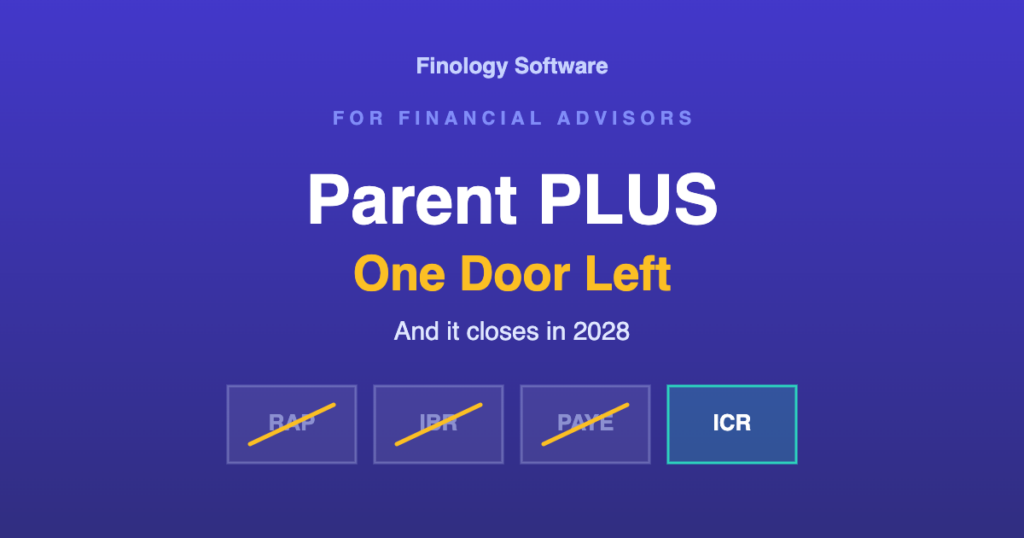
Parent PLUS is now the least flexible debt in the federal system, and the window that used to fix that has closed. If you have clients carrying loans they took out for a child, the menu in front of them is smaller than almost anyone realizes, and one of the remaining doors closes in 2028.
Here is the current state, with the citations, because this is an area where general advice is usually wrong.
A Parent PLUS loan on its own has no income-driven option
Not a reduced one. None.
An unconsolidated Parent PLUS loan is eligible for the fixed plans only: Standard, Extended Fixed, Graduated, and Extended Graduated. It cannot be repaid under RAP, IBR, PAYE, or ICR.
This is the single most common error in student loan advice. Any tool, article, or servicer script that offers a parent an income-driven menu is describing a loan they do not have. If your client has been told to “just get on an income-driven plan,” that conversation was wrong before it started.
Consolidating unlocks exactly one income-driven plan, and it is not RAP
Consolidating Parent PLUS into a Direct Consolidation Loan opens access to ICR only.
Under 34 CFR 685.209(c)(5)(ii)(A), a borrower may choose ICR to repay a Direct Consolidation Loan that repaid a parent Direct PLUS or parent Federal PLUS loan. And under (c)(5)(iii)(A), a consolidation disbursed on or after July 1, 2025 that repaid Parent PLUS “may not choose any IDR plan except the ICR plan.”
RAP is not available to these loans. Neither is IBR. The consolidation buys one door, not the whole hallway.
What ICR actually does for a parent
Advisors tend to assume the consolidation is obviously worth it. Run against real balances, it usually is not, and it is worth knowing why before you recommend an irreversible move.
We modeled two parents through our calculation engine at an 8.05% rate, with income growing 3% a year:
| Client | Standard | Extended Fixed | ICR after consolidating |
|---|---|---|---|
| $60k balance, $70k income | $730/mo · $87,546 total | $465/mo · $139,523 | $651/mo · $91,184 |
| $100k balance, $60k income | $1,216/mo · $145,910 total | $775/mo · $232,540 | $734/mo · $197,315 |
Two things fall out of that.
ICR is cash-flow relief, not savings. For the first parent it lowers the payment by $79 a month and costs about $3,600 more overall. For the second it lowers the payment by $482 a month and costs roughly $51,000 more.
Forgiveness usually never arrives. ICR forgives at 300 payments. Neither of these borrowers reaches it, because the payment is high enough to retire the loan first. The forgiveness that justifies the consolidation in most people’s heads does not show up at typical parent balances.
So the honest framing for a client is that consolidating to ICR buys a smaller payment now at a real cost later. For a parent who cannot make the Standard payment, that is a good trade and possibly the only one available. For a parent who can, it usually is not.
The 2028 cliff
ICR closes. Under 685.209(c)(7), borrowers repaying under ICR must elect a different plan before July 1, 2028.
For most borrowers that is routine, because they can move to RAP or IBR. For a consolidation that repaid Parent PLUS, neither of those is available. That cohort has the shortest runway and the fewest exits in the entire system, and the rules for where they land are still being written.
This is the thing to calendar now rather than discover in 2028.
The new-loan trap
Both Parent PLUS carve-outs carry the same shutoff. Paragraph (B) under each of (c)(5)(ii) and (c)(5)(iii) provides that the carve-out shall not apply if that borrower received a Direct Loan on or after July 1, 2026.
Read that against a real family. A parent consolidates to reach ICR, then goes back to school themselves for a credential, or takes another Parent PLUS loan for a second child. The new loan switches off the only income-driven plan they had, and RAP was never available. What remains is the fixed plans, at any income.
If a client has Parent PLUS debt and anyone in the household is considering new federal borrowing, those two decisions have to be made together.
One thing the regulation does not resolve
There is a genuine ambiguity here, and we would rather flag it than paper over it.
Paragraph (c)(5)(ii)(A) permits ICR for a consolidation loan disbursed “on or after July 1, 2006,” a window that plainly contemplates consolidations happening now. But paragraph (B) removes that permission if the borrower “received a Direct Loan on or after July 1, 2026.” A Direct Consolidation Loan is itself a Direct Loan.
On a literal reading, a parent who consolidates today could be disqualified by the very loan that was supposed to qualify them. On a purposive reading, (B) is aimed at new borrowing, not at the consolidation itself, which is the only interpretation that leaves (A) with any work to do after July 2026.
We do not think anyone should guess at this. If a client is considering consolidating Parent PLUS now specifically to reach ICR, get the servicer’s position in writing through the secure message center before the application goes in. A written answer is worth having either way, and this is not a decision that can be unwound.
What to do this month
- Identify every client with Parent PLUS debt, including loans they do not think of as theirs because the child is repaying them informally.
- Check whether it is already consolidated. That single fact determines the entire menu.
- Model Standard against ICR on their actual numbers before recommending consolidation. The relief is real; so is the cost.
- Ask about new borrowing in the household. One disbursement can close the door permanently.
- Calendar 2028 for anyone sitting on ICR today.
Model any client’s Parent PLUS options at finology.tech. Already have an account? Log in.
Source: 34 CFR 685.209, current text as of August 2026. Figures are engine illustrations, not projections of any specific borrower’s loans.
Show every client the plan that saves them the most
Every number sourced, every path compared. Model RAP, the new Standard, IBR, PAYE, ICR and PSLF side by side.