
Does Married Filing Separately Still Lower Student Loan Payments Under RAP?
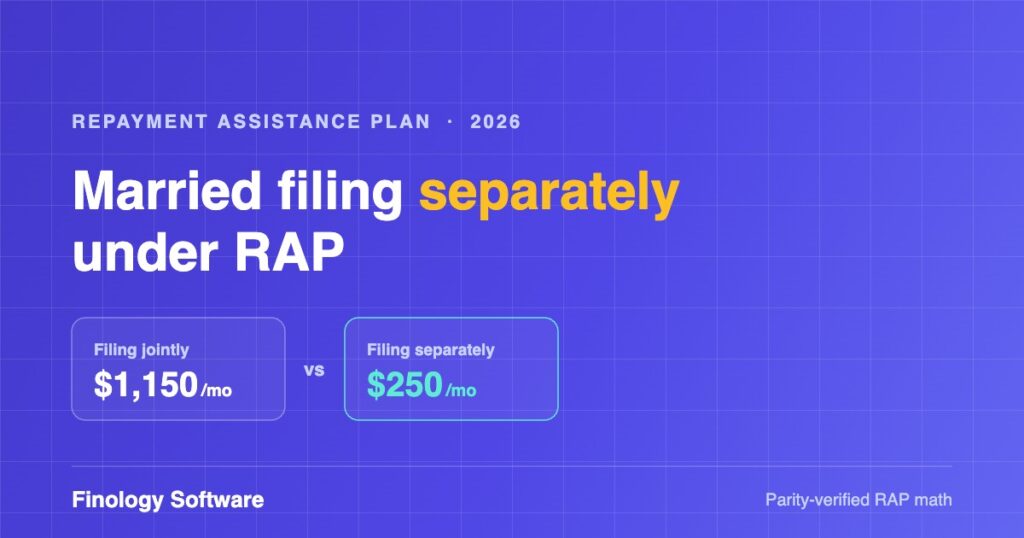
Yes. Under the Repayment Assistance Plan (RAP), a married borrower who files a separate federal tax return keeps their spouse’s income out of the monthly payment calculation. For a dual-income couple where one spouse carries the loans, that can cut the RAP payment by hundreds of dollars a month. The catch is that the lowest monthly payment is not always the cheapest way out of the debt, and that tradeoff is exactly what a client will ask you to run.
How does RAP decide whose income counts?
RAP bases the monthly payment on adjusted gross income (AGI). If a married borrower files jointly, RAP counts the couple’s combined AGI. If they file separately, RAP counts only the borrower’s AGI. Federal Student Aid states the rule plainly for income-driven plans: the servicer will use only your income if you file taxes separately from your spouse.
That single choice, joint or separate, is the biggest lever a married borrower has over a RAP payment. RAP scales the payment from 1% to 10% of AGI, rising one percentage point for every $10,000 of income, so pulling a spouse’s salary out of the number can move the borrower down several brackets at once.
How much can filing separately lower a RAP payment?
It depends on the income gap, but for a couple with a real second income it is often a difference of hundreds of dollars a month. The table below runs one borrower through RAP under three filing scenarios, holding everything else equal, so the only thing changing is whose income RAP counts.
Assumptions: a borrower with $60,000 in Direct Unsubsidized loans at 6.5%, borrower AGI $70,000, two dependents claimed, enrolled in RAP, not pursuing PSLF, no assumed annual income growth. The dependent count is held at two across all three rows to isolate the income effect.
| Filing scenario | Income RAP counts | RAP monthly payment | 30-year outcome | Total out of pocket* |
|---|---|---|---|---|
| Married filing jointly, spouse AGI $80,000 | $150,000 combined | $1,150 | Paid in full before forgiveness | $70,632 |
| Married filing jointly, spouse AGI $40,000 | $110,000 combined | $817 | Paid in full before forgiveness | $76,584 |
| Married filing separately | $70,000, borrower only | $250 | Balance forgiven at month 360 | $99,365 |
Why is the lower payment sometimes the more expensive choice?
Because a smaller monthly payment can stretch the loan across the full 30 years and end in a taxable forgiveness event, while a larger payment retires the balance early with less interest and no tax. In the table above, married filing separately produces the lowest payment at $250 but the highest total cost at $99,365, because the borrower-only payment never fully retires the balance and the amount forgiven at month 360 is taxed as income.
The Congressional Research Service makes the same point about RAP’s long clock: borrowers who ride the 30-year maximum may end up paying more out of pocket over the lifetime of their loans. Filing separately also carries its own tax cost. Federal Student Aid warns that separate filing can make some income-driven plans more affordable, but you could also pay more tax and lose benefits, including a more favorable bracket and the student loan interest deduction. The right answer for a client is a net-of-tax comparison, not a payment comparison.
Does the math flip for PSLF clients?
Yes, and this is where filing separately usually wins. A borrower pursuing Public Service Loan Forgiveness wants the lowest qualifying payment for 120 months, because whatever remains is forgiven tax-free. Keeping a spouse’s income out of the RAP payment lowers every one of those 120 payments and increases the tax-free forgiveness at the end. For PSLF-tracked borrowers the higher lifetime cost shown above does not apply, since forgiveness arrives at 10 years without a tax bill.
What happens to dependents when a client files separately?
RAP reduces the monthly payment by $50 for each dependent, but a separate filer can only count the dependents claimed on their own return. If a couple normally claims two children jointly and shifts to separate returns, those dependents move to one spouse’s return, so the borrower may lose part of the $50-per-dependent reduction. The payment table above holds dependents constant to isolate the income effect. In a real plan you would model the dependents as they will actually be claimed.
Which clients is this worth running for?
The play pays off when one spouse carries most of the federal loan balance and the other earns a meaningful income. A borrower married to a high earner with little or no student debt can see the largest drop, since separate filing removes the entire second income from the calculation. It matters far less when both spouses have similar incomes and similar loan balances, because RAP already reduces a joint payment to account for a spouse’s own federal loans. Run both filing arms, net of the extra income tax, before you tell a client which way to file.
Frequently asked questions
Does married filing separately lower student loan payments under RAP?
Yes. RAP counts only the borrower’s adjusted gross income when a married borrower files a separate federal return, so a spouse’s income is excluded. This lowers the payment when the spouse earns a meaningful income.
Does a spouse’s income count on RAP if we file jointly?
Yes. If a married borrower files a joint federal tax return, RAP uses the couple’s combined AGI. The payment is reduced if the spouse also has federal student loans.
Is filing separately always the cheaper option under RAP?
No. Filing separately usually lowers the monthly payment, but it can raise the total cost by extending repayment to 30 years and adding a tax on the forgiven balance, plus the higher income tax that separate filing often triggers. Compare net of tax, not payment to payment.
When does filing separately clearly win under RAP?
When the borrower is pursuing Public Service Loan Forgiveness, or is married to a high earner with little federal student debt. In both cases, excluding the spouse’s income lowers the qualifying payment, and for PSLF the remaining balance is forgiven tax-free at 10 years.
The advisor value here is not the rule, it is the number. A client wants to know what filing separately actually saves them after the extra tax, and whether the lower payment costs more over the life of the loan. Finology Software runs both filing arms with parity-verified RAP math, so you can put the joint payment, the separate payment, and the lifetime cost side by side and give a client an answer they can act on.
- How Does Family Size Affect Student Loan Payments in 2026? RAP’s $50 Rule vs the Poverty Line
- The Student Loan Interest Deduction in 2026: What Your Clients Can Still Claim
- Should Medical Students File Taxes? Why a $0 Return Can Mean $0 Loan Payments
- How to Tell If Your Program Will Still Qualify for Federal Student Loans
Put your plan where you can see it
Add your loans and your plan in a free borrower account. See your payoff date, watch your progress, and know exactly what an extra $50 a month changes.