Should Medical Students File Taxes? Why a $0 Return Can Mean $0 Loan Payments
Most medical students skip filing taxes for a simple reason: they earn almost nothing, they owe nothing, and the IRS does not require a return. It feels like a chore you get to skip.
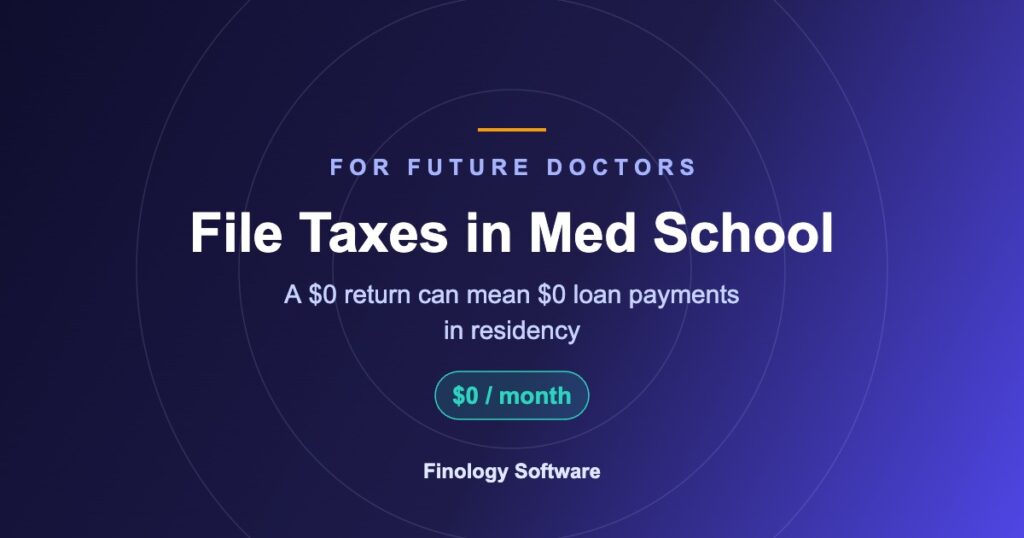
That skipped return is often the most expensive shortcut in medicine. For many doctors it is the difference between paying $0 a month on their student loans during residency and paying several hundred a month, during the exact years they can least afford it.
Your loan payment is set by your last tax return
Income-driven repayment plans, including IBR and the new RAP plan, calculate your monthly payment from the adjusted gross income on your most recent federal tax return. Not your job title. Not your future attending salary. The number on the return.
A medical student who files a return showing little or no income has just created the single most valuable document of their early repayment years: official proof of a near-zero AGI.
The intern-year fork in the road
Federal loans typically enter repayment about six months after graduation, which lands in the middle of intern year. At that moment there are two versions of you.
The version that filed. Your income-driven payment can be set from your med-school tax return. With an AGI near zero, an IBR payment comes out to $0 per month.
The version that did not file. With no return to point to, you document income with your current pay stubs instead. A typical intern salary in the mid $60,000s sets a payment of a few hundred dollars a month.
Both versions are officially in repayment. One of them keeps hundreds of dollars a month through the leanest years of a medical career.
$0 payments still count
This is the part that surprises almost everyone. A $0 income-driven payment is a real, qualifying payment.
- It counts toward income-driven forgiveness.
- It counts toward Public Service Loan Forgiveness if you work full time for a qualifying employer. Most academic medical centers and nonprofit hospitals qualify.
Residency is usually the cheapest PSLF-qualifying stretch a doctor will ever have. A typical residency plus fellowship can bank five or more of the ten required years. Every $0 month you collect as a resident is a month you will not be paying at attending income later.
How to actually do this
- File a federal return for your medical school years, even if your income is $0 and you are not required to file. IRS Free File handles a return like this in about fifteen minutes.
- Time your application honestly. There is a window between graduation and your first resident paycheck when that low return still fairly reflects your income. That window, not some trick on the form, is how the $0 first year happens. Many graduates also use consolidation to start repayment early inside it.
- Use the tax return, not pay stubs, when you certify income for your plan.
- Keep filing every year. Your payment generally holds for about twelve months before you recertify. Your intern-year return only shows half a year of resident income, which keeps year two low as well.
Married in residency? One more decision
If you are married, your filing status changes the math again. Filing separately can keep a spouse’s income out of your payment calculation on IBR and RAP, but it usually costs something on the tax side. This tradeoff is worth modeling with real numbers rather than guessing, and it is one of the most common places we see doctors overpay.
If your loans are newer
Loans first borrowed after July 1, 2026 fall under RAP, the repayment plan created by the 2025 law. The principle is identical: your payment keys off the AGI on your latest tax return. RAP has a $10 monthly minimum instead of $0, so filing in school still sets your payment at the floor.
The habit that pays for itself
Filing a $0 return takes minutes. Skipping it can cost a resident thousands of dollars a year and slow the forgiveness clock that residency is quietly filling for you. If you are in medical school now, file this spring. Your intern-year self will thank you.
See your exact payment before intern year does
Run your real loans through the same verified engine financial advisors use. It takes a few minutes and shows your payment on every plan you qualify for.
Check my numbersFinancial advisor? Start here instead
Put your plan where you can see it
Add your loans and your plan in a free borrower account. See your payoff date, watch your progress, and know exactly what an extra $50 a month changes.