Did the New PSLF Employer Rule Take Effect? What Advisors Need to Know
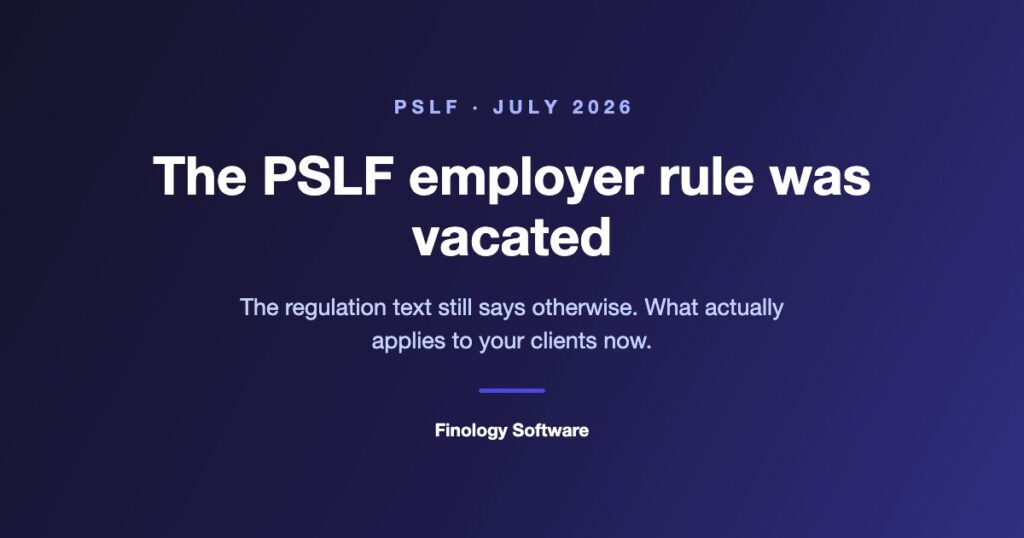
No. The Department of Education’s rule narrowing which employers qualify for Public Service Loan Forgiveness was vacated by a federal court on June 30, 2026, one day before it was scheduled to take effect. PSLF employer eligibility is being administered under the prior definition. If a client at a nonprofit was told their employer might stop counting, that did not happen.
There is a wrinkle worth knowing about, because it is already producing wrong answers: the regulation text you will find if you look up the rule still contains the vacated language. Details below, along with the July 1 PSLF changes that did survive.
Did the new PSLF employer rule take effect on July 1, 2026?
No. On June 30, 2026, a federal district court in Massachusetts vacated the rule in National Council of Nonprofits et al. v. McMahon, holding that it was contrary to law, exceeded the Department’s statutory authority, was arbitrary and capricious, and violated the First Amendment. A separate federal court in the District of Columbia struck the same rule down that day. The rule never took effect.
Background: the Department published the final rule on October 31, 2025, with a July 1, 2026 effective date. It would have added a conduct-based test to the existing, largely status-based employer definition, excluding organizations determined to have a “substantial illegal purpose.” The Department estimated that fewer than 10 employers per year would be disqualified under it. Plaintiffs included several cities, three national labor unions, and a group of nonprofit legal services and social work organizations.
Sources: NASFAA, AFT (a plaintiff), NACUBO on the original rule.
Which employers qualify for PSLF right now?
The definition that applied before the vacated rule. Under 34 CFR 685.219, a qualifying employer is any of the following:
- A United States-based federal, state, local, or tribal government organization, agency, or entity, including the U.S. Armed Forces or the National Guard
- A public child or family service agency
- A 501(c)(3) organization exempt from taxation under section 501(a) of the Internal Revenue Code
- A tribal college or university
- A nonprofit organization that provides a non-governmental public service and is not a business organized for profit, a labor union, or a partisan political organization
The mechanics are unchanged too. The borrower needs 120 qualifying monthly payments made after October 1, 2007 on eligible Direct loans, while employed full-time by a qualifying employer both when the 120th payment is satisfied and when forgiveness is requested. Full-time means an average of at least 30 hours per week across one or more qualifying jobs.
Why does the regulation text still show the vacated language?
Because the published compilation has not caught up with the court. This is the part that will trip people up, so it is worth being concrete.
On July 29, 2026 we pulled section 685.219 directly from the eCFR versioning API for two editions. In the June 15, 2026 edition, the phrase “substantial illegal purpose” appears zero times and the qualifying-employer definition has no exclusion clause. In the July 27, 2026 edition, the phrase appears 18 times, and the definition carries a new subparagraph excluding organizations that “engage in activities such that they have a substantial illegal purpose.”
That is the vacated rule, still sitting in the compiled text. The eCFR is an unofficial editorial compilation that incorporates amendments by their stated effective date. A court vacatur does not remove text from it automatically. The compiled section stays as-is until the Department publishes a document in the Federal Register removing the language.
The practical version for an advisor: if you look up the PSLF employer rule today and find the restriction, you are reading language a court has already thrown out. Check the litigation status before you repeat what the section says.
Which July 1, 2026 PSLF changes did take effect?
The repayment plan changes. The vacatur reached the employer eligibility rule only, so a separate set of amendments to the “qualifying repayment plan” definition took effect on schedule. The same eCFR pull confirms two that matter:
- RAP counts. The Repayment Assistance Plan is now listed as a qualifying repayment plan for PSLF. See RAP and PSLF for how the two interact.
- ICR is on a clock. Income-contingent repayment now qualifies only for a payment received on or before June 30, 2028.
So “the PSLF rule was struck down” is not the same statement as “the July 1 PSLF changes were struck down.” The employer side reverted. The plan side moved, and the plan side is where your client’s money is.
How much does the repayment plan choice cost a client pursuing PSLF?
More than most clients expect. For a single borrower with $145,000 in Direct Unsubsidized loans at 6.8% and an $85,000 AGI, the gap between the most and least expensive qualifying plan is $139,180 across the PSLF window. Same employer, same 120 months, same forgiveness. Only the plan differs.
| Qualifying plan | Monthly payment | Total paid | Forgiven at month 120 | Tax on forgiveness |
|---|---|---|---|---|
| Standard (10-year) | $1,669 | $200,240 | $0 | $0 |
| RAP | $567 | $68,000 | $138,265 | $0 |
| IBR | $509 | $61,060 | $181,378 | $0 |
Two things in that table are worth saying out loud to a client.
First, the Standard plan is a qualifying plan, and it is still the wrong answer here. It pays the loan off in month 119. There is no balance left for PSLF to forgive in month 120, so the client works ten years in public service and receives nothing for it. A borrower who defaults into Standard because nobody looked pays $200,240 instead of $61,060.
Second, the tax column is zero on purpose. Forgiveness under PSLF does not create a tax liability, which the IRS Taxpayer Advocate Service states directly. That is not true of every forgiveness path, so it is a real part of the case for PSLF.
One note on availability: for this loan type, the engine returned PAYE and ICR as closed to new enrollment as of July 29, 2026. Plan menus are narrower than most published comparisons suggest, which is its own reason to check a specific file rather than a general chart.
What should you do for PSLF clients this month?
- Reassure the nonprofit employees you already worried. Anyone you warned in late 2025 about losing employer eligibility should hear that the rule was vacated and their employer still qualifies.
- Keep certifying employment on the normal cadence. Nothing about the certification process changed, and a clean certification history is what protects a client if the rules move again.
- Audit the plan, not just the employer. Employer eligibility was never where the money was. Any PSLF client sitting on a Standard plan is on track to receive no forgiveness at all.
- Watch for an appeal. This was a trial court decision, so the Department can take it to the First Circuit. Nothing changes for clients unless and until an appellate court says so.
Frequently asked questions
Is my client’s nonprofit employer still eligible for PSLF?
Yes, assuming it met the definition before. The rule that would have narrowed employer eligibility was vacated on June 30, 2026 and never took effect. A 501(c)(3), a government employer, a tribal college, or a nonprofit providing a qualifying public service all still count under 34 CFR 685.219.
Does RAP count toward PSLF?
Yes. The Repayment Assistance Plan is listed as a qualifying repayment plan for PSLF in the regulation as amended effective July 1, 2026. That change was not affected by the court decision on employer eligibility.
Can a client on the Standard plan get PSLF?
Technically yes, practically often no. The 10-year Standard plan is a qualifying repayment plan, but it is built to retire the loan in about 120 months. If the balance reaches zero on or before the 120th payment, there is nothing left to forgive. Most PSLF candidates are better served by an income-driven plan.
Why does the regulation still list the “substantial illegal purpose” exclusion?
The eCFR is an editorial compilation that incorporates amendments on their effective date. It does not remove text automatically when a court vacates a rule. The language stays in the compiled section until the Department of Education publishes a Federal Register document removing it. The court decision controls in the meantime.
The advisor takeaway
The employer scare is over, and it was always the smaller number. The client who loses $139,180 loses it to a repayment plan nobody checked, not to a rulemaking. Finology Software exists so that the number you hand a client is one you can stand behind, computed against current regulation rather than a chart that went stale in July.
Run a client’s plan comparison free
Put your plan where you can see it
Add your loans and your plan in a free borrower account. See your payoff date, watch your progress, and know exactly what an extra $50 a month changes.