Published by Finology Software · For borrowers and students
If you are in school, heading to school, or helping someone who is, you may have seen headlines saying certain degree and certificate programs will lose access to federal student loans. Here is what the rule actually does, who it touches, and when.
What changed
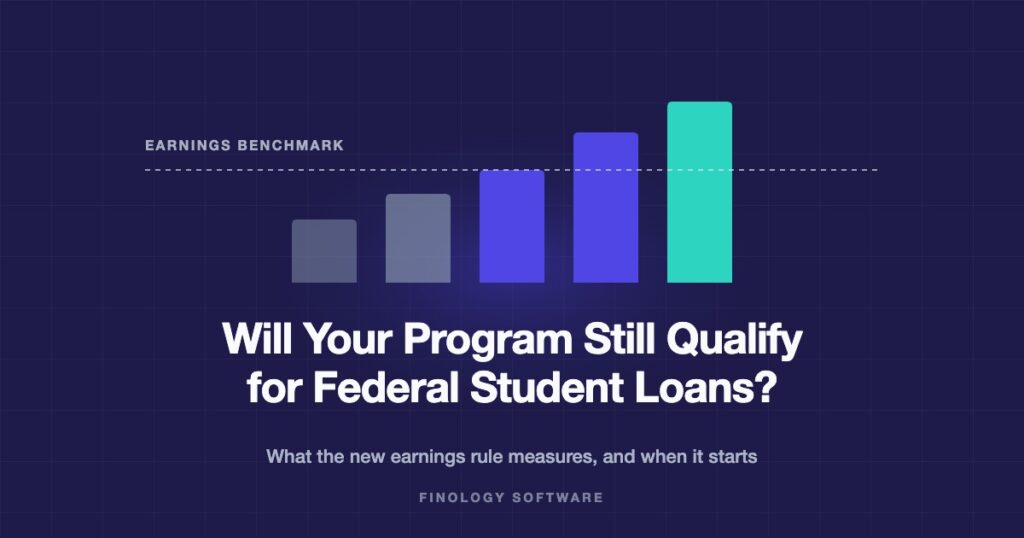
The Department of Education finalized a rule that ties a program’s access to federal Direct Loans to what its graduates actually earn. It works at the program level, not the student level. Your grades, your income, and your loan balance have nothing to do with whether a program passes.
The test in plain terms
For an undergraduate program, the graduates are compared to the median earnings of adults ages 25 to 34 in that state who have only a high school diploma. In California that comparison figure is roughly $36,000 a year. The number is state specific, so it differs depending on where the school is.
For a graduate program, the comparison is to bachelor’s degree holders in the same age range.
Earnings are measured in the fourth tax year after a student completes the program. If a program comes in under its benchmark in two out of any three consecutive years, it loses eligibility for federal Direct Loans for at least two years.
Who this does not affect
If you already have federal student loans, this rule does not touch them. It does not change your balance, your interest rate, your repayment plan, your monthly payment, or your progress toward forgiveness. Nothing you have already borrowed is affected.
This is about whether future students at a given program can borrow federally.
When it starts
The framework takes effect July 1, 2027, with schools able to opt in a year early. The Department expects to run the first earnings calculations in early 2027, and the earliest a program could actually be designated as low earning is the 2028 to 2029 aid year. Programs in tipped income occupations, including cosmetology, have roughly an extra year.
The Department estimates the large majority of programs will pass. Certificate programs in personal grooming fields are expected to have the highest failure rates, and programs in social work, the arts, and education support roles have also been flagged as at risk.
You will get a warning first
This is the part worth knowing. Schools are required to notify enrolled and prospective students after a program fails even once, well before eligibility is actually lost. If you receive one of those notices, it is not a shutoff. It means the program missed the benchmark for one year and could lose federal loan access if the pattern continues.
Grant aid is a separate question. Pell Grants are only at risk in a narrower case, where low earning programs make up more than half of a school’s federal aid recipients or dollars.
What to do with this
If you are repaying loans: nothing here requires action from you.
If you are choosing a program: ask the school what its completers earn four years out. That figure is now the number that governs the program’s federal loan access, and schools are increasingly able to produce it.
If you receive a failure notice: you have time. Use it to confirm the program’s trajectory and to understand what your funding would look like without federal loans.
If a program does lose eligibility: the practical effect is that students there would need private loans, which are credit based and do not carry income driven repayment, federal forgiveness, or Public Service Loan Forgiveness. That tradeoff is worth modeling before you commit, not after.
The rule is measuring one thing: whether a program’s graduates out-earn the benchmark. Knowing where your program stands, and what your repayment would look like either way, puts the decision back in your hands.
If you are already repaying federal loans and want to understand your own numbers, the bigger change to know about is the one that took effect this July: the Repayment Assistance Plan is now the default income driven plan. We broke that down here: RAP Is Here: What the New Default Repayment Plan Means.
Sources: NPR; CalMatters; NASFAA, ED Publishes Final Regulations Implementing OBBBA Accountability Framework; Nixon Peabody, Department of Education Finalizes OBBB Higher Ed Accountability Rule.
Put your plan where you can see it
Add your loans and your plan in a free borrower account. See your payoff date, watch your progress, and know exactly what an extra $50 a month changes.